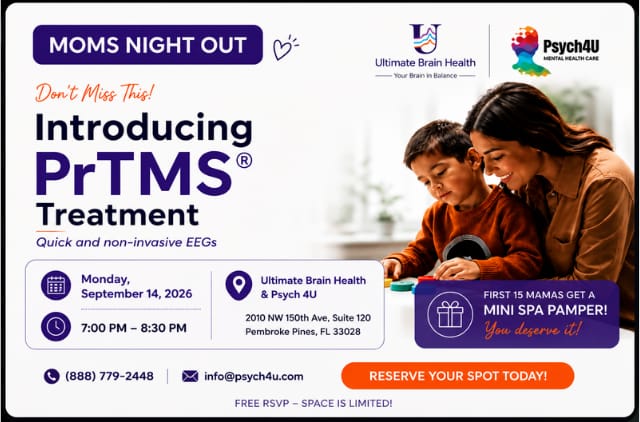
TMS Therapy at Psych 4 U
Psych 4U is proud to provide Ultimate Brain Health TMS and PrTMS
Non-invasive, medication-free support for depression, Anxiety and OCD.
When symptoms keep getting in the way of daily life, it can feel discouraging — especially when medication, therapy, or previous treatment plans have not brought enough relief. At Psych 4 U , we offer Ultimate Brain Health Transcranial Magnetic Stimulation, also known as TMS therapy, as part of our commitment to comprehensive, personalized psychiatric care.
TMS uses gentle magnetic pulses that go right to the areas of the brain that control mood, focus, emotional regulation, and behavior patterns.
It does not require surgery, anesthesia, or downtime.
TMS evaluations are available for people experiencing symptoms related to depression, anxiety, OCD, ADHD and more.
TMS is covered by insurance for certain disorders. If what you are struggling with is not covered we work with you to help reduce cost and we have financing options available.
Every treatment plan begins with a thoughtful evaluation to understand your needs, your history, and whether TMS may be a good fit.
You will receive a quick non-invasive scan allowing our providers to actually see how your brain is functioning. They will read this with you and discuss your options. Let’s get you on a better path today!
You’re not broken. You’re human. And support should meet you where you are.
Traditional TMS is covered for MDD, OCD, Anxious Depression by most insurances and Medicare and for PTSD for Tri-Care.
Do you need to talk to a mental health counselor, psychiatrist, or therapist?
Book Appointment
When Medication Hasn't Been Enough
If you’ve tried one antidepressant after another and still don’t feel like yourself, you are not alone, and you are not out of options.
Depression is one of the most common conditions we treat, and for many people, medication works well. But a large share of patients don’t get full relief from the first or second prescription. Research consistently shows that each additional medication trial tends to offer a smaller chance of recovery than the one before, and adding or combining medications can bring more side effects along with it.
That’s why Psych 4 U offers Transcranial Magnetic Stimulation (TMS) at our Pembroke Pines office. TMS was first cleared by the FDA in 2008 for adults with depression that has not responded to medication, and it has since become one of the most well-studied treatment options for people who feel stuck.
What Is TMS Therapy?
TMS is a non-invasive, outpatient treatment that uses focused magnetic pulses to stimulate specific areas of the brain involved in mood. There is no anesthesia, no sedation, and no downtime. You stay awake and alert during each session, and you can drive yourself home or go straight back to work or school.
Treatment is typically given in short sessions, five days a week, over several weeks. Your provider will walk you through the schedule that fits your plan.
How TMS Works
Brain imaging studies show that in many people with depression, the front part of the brain responsible for focus, planning, and emotional control (the left prefrontal cortex) is less active than it should be. At the same time, the deeper brain regions that drive emotional reactions can be working overtime.
During TMS, a magnetic coil is placed gently against the scalp over the prefrontal area. The pulses encourage the underactive nerve cells to fire more normally. Over a course of treatment, this helps strengthen the brain’s mood-regulating circuits and bring these two systems back into better balance.
Think of it as retraining the brain’s communication pathways, rather than adding another chemical to the mix.
Conditions TMS May Help Support
At Psych 4 U , TMS may be explored as part of a personalized care plan for:
Depression
Treatment-resistant depression
Anxiety symptoms
OCD
ADHD-related symptoms
Autism-related symptoms
Mood regulation challenges
Focus and attention concerns
Emotional or behavioral dysregulation
For autism, TMS is approached carefully and individually. It may be considered as part of a broader support plan after an evaluation, especially when there are concerns related to regulation, attention, anxiety, or repetitive patterns. Because every autistic person is different, the goal is not to “change who someone is,” but to explore whether TMS may support comfort, functioning, and quality of life.
Let’s make space for your story — not just your symptoms.
Different Types of Therapy
TMS for Depression
Depression can affect energy, motivation, sleep, concentration, relationships, and the ability to feel like yourself. For some people, antidepressant medication and therapy help. For others, symptoms continue despite trying multiple treatment options.
TMS may be recommended for people with depression when previous treatments have not provided enough relief. It works by stimulating areas of the brain involved in mood regulation. Mayo Clinic describes TMS as a non-invasive treatment that uses magnetic fields to stimulate nerve cells in the brain and is typically used when other depression treatments have not been effective.
TMS for OCD
OCD can involve intrusive thoughts, urges, repetitive behaviors, or mental rituals that feel difficult to control. TMS may be used as an adjunct treatment for OCD, meaning it can be part of a larger care plan that may also include therapy, medication management, and ongoing psychiatric support.
The FDA permitted marketing of a deep TMS system for adults with OCD, and Medicare coverage guidance recognizes TMS as FDA-approved for depression and OCD.
TMS for Autism-Related Symptoms
For autism, TMS is approached carefully and individually with PrTMS. It may be considered as part of a broader support plan after an evaluation, especially when there are concerns related to regulation, attention, anxiety, or repetitive patterns. Because every autistic person is different, the goal is not to “change who someone is,” but to explore whether PrTMS may support comfort, functioning, and quality of life.
Let’s make space for your story — not just your symptoms. Make an appointment today.
Advanced Treatment with the Apollo TMS Therapy System
Psych 4 U uses the Apollo TMS Therapy system by neurocare group, one of the most versatile TMS platforms available today. Apollo holds FDA clearance for three uses:
Adults with depression who have not had enough improvement from oral antidepressants
Adolescents with major depressive disorder, cleared by the FDA in 2025
Adults with obsessive-compulsive disorder (OCD), as an add-on treatment when traditional therapies haven't provided enough relief
This matters for families. For teens with depression, medication options are limited, and TMS offers a drug-free approach to discuss with your child’s psychiatric provider. And because Psych 4 U specializes in anxiety and OCD, Apollo allows us to offer adults living with OCD a treatment option beyond therapy and medication alone.
Our certified TMS providers will explain which treatments are appropriate based on your or your child’s age, diagnosis, and treatment history.
What Results Can You Expect?
Every patient is different, but TMS has shown meaningful results for people who have already tried multiple medications. In clinical studies and real-world practice, many patients experience a significant reduction in symptoms, and a substantial number reach full remission. For a group that has often been through years of trial and error, these outcomes are genuinely encouraging.
Many patients begin noticing changes, such as better sleep, more energy, or improved motivation, partway through their treatment course.
Is TMS a Complete Solution?
Depression rarely has a single cause. Genetics, long-term stress, trauma, life changes, and brain chemistry can all play a role. TMS directly targets the brain activity patterns connected to depression, but lasting recovery usually comes from treating the whole person.
That’s where Psych 4 U is different. Because we offer psychiatry, medication management, and counseling under one roof, your TMS treatment can be coordinated with the rest of your care. Your team works together so that therapy, medication adjustments, and TMS all support the same goal: helping you feel better and stay better.
Do you need to talk to a mental health counselor, psychiatrist, or therapist?
Book Appointment
Benefits of TMS Therapy
TMS may be a helpful option for people looking for treatment that is:
Non-invasive
Medication-free
Performed in-office
Able to fit into a broader psychiatric care plan
Designed with little to no downtime
Personalized to the individual
Supportive for people who have not found enough relief from traditional approaches
At Psych 4 U , TMS is not offered as a one-size-fits-all treatment. It is part of a thoughtful care process that may also include psychiatric evaluations, medication management, counseling, family support, and ongoing follow-up.
Is TMS Safe?
TMS is generally very well tolerated. The most common side effects are mild scalp discomfort or a headache during or shortly after treatment, and these typically fade as sessions continue. Because TMS doesn’t circulate through the body like medication, it avoids common medication side effects such as weight gain, drowsiness, or sexual side effects.
All TMS sessions at Psych 4 U are delivered by certified TMS providers under physician oversight.
Who May Be a Good Candidate?
TMS may be right for you if you:
- Have been diagnosed with major depressive disorder (adults or adolescents)
- Are an adult with OCD that hasn’t improved enough with therapy or medication
- Have tried one or more antidepressants without enough improvement
- Couldn’t tolerate the side effects of medication
- Prefer a non-drug treatment option
- Are looking for an alternative to more intensive treatments
TMS is not appropriate for everyone. For example, people with certain metal implants in or near the head may not be eligible. A Psych 4 U provider will complete a full evaluation to determine whether TMS is a safe and appropriate choice for you.
PrTMS at Psych 4 U
PrTMS®: Personalized TMS Guided by Your Brain Waves
In addition to standard TMS, Psych 4 U offers PrTMS® (Personalized Repetitive Transcranial Magnetic Stimulation), an individualized approach developed by Dr. Kevin T. Murphy.
Traditional TMS uses the same stimulation settings and target area for most patients. PrTMS takes a different path. Before and throughout treatment, we record your brain’s electrical activity with a quick, painless EEG (brain wave) scan. That data is analyzed to find your brain’s own natural rhythm, and your stimulation frequency and treatment locations are set to match it.
How PrTMS is different:
- Built around your brain map. Treatment settings come from your EEG results, not a one-size-fits-all formula.
- Adjusted as you progress. Brain activity is re-measured regularly, and your plan is fine-tuned as your brain responds.
- Gentle, multi-area stimulation. PrTMS typically uses lower-intensity pulses and may address several areas of the brain rather than a single spot.
- Progress you can see. Follow-up EEG scans let you and your provider track changes in brain activity alongside how you feel.
Who May Benefit From PrTMS
PrTMS is being studied for a range of conditions where brain wave patterns may be out of balance. Published research has reported encouraging early results in areas such as PTSD and persistent concussion symptoms, and clinicians are exploring its use for other conditions, including anxiety, ADHD, and autism spectrum disorder.
Your Psych 4 U provider will review your history and EEG results to determine whether PrTMS is appropriate and how it fits with your overall treatment plan.
Important: PrTMS is a personalized treatment protocol, not a separately FDA-cleared treatment. Its use for conditions outside of FDA-cleared TMS indications is considered off-label, and research is still ongoing. PrTMS may not be covered by insurance. Our team will review costs, expected benefits, and alternatives with you before treatment begins.
Ask About PrTMS
TMS at Psych 4 U
Psych 4 U provides psychiatric care that is thoughtful, accessible, and centered around real life. Our services include diagnostic evaluations, medication management, counseling, telehealth psychiatry, child and adolescent psychiatry, and advanced treatment options like TMS.
We work with children, teens, adults, older adults, and families. Whether you are seeking care for yourself or someone you love, we are here to help you understand your options and take the next step with clarity.
Mental health shouldn’t be out of reach.
Does Insurance Cover TMS?
Most insurance plans cover TMS for adult depression, and a growing number of plans are extending coverage to adolescents and OCD. Coverage usually requires meeting certain criteria, such as having tried a set number of medications. Our team will help verify your benefits and handle the prior authorization process so you know what to expect before you begin.
Start Your TMS or PrTMS Journey at Psych 4 U
If depression has been holding you back despite your best efforts, TMS may open a new door. Our compassionate team in Pembroke Pines is here to answer your questions and help you decide whether TMS or PrTMS is the right next step.
Request a TMS Consultation
Serving Pembroke Pines, Miramar, Weston, Hollywood, Davie, and communities throughout Broward and Miami-Dade.